Tuesday, 25 September 2012

Granada and the Alhambra

I had wanted to see Granada and the Alhambra for years, last April I finally persuaded my husband to leave his bike for a long week-end. Granada is about a two hour drive from Aguilas along quiet, jam free autovias, a far cry from out packed motorways.The closer we got to Granada the more mountainous it became until at last we saw the snow capped Sierra Nevada rising up behind the city.
     We found the hotel on the outskirts easily but had to drive around it twice before locating the entrance to the subterranean car park. The traffic in and around Granada is pretty scary and I wouldn't reccommend booking a hotel in the old centre, (even though it's undoubtedly picturesque), unless you have nerves of steel and a good sense of direction - or (possibly) Satnav.
     When we reached our hotel room I found that in the short time that it had taken us to walk from the car park and check in my camera had vanished. I will never know if it fell out or was taken from my bag.Not a good start for me, but I suspect the husband had a job to suppress his joy - I do spend an inordinate amount of time taking photos. (All the ones in this post have been supplied by the net or kind friends).
 
     We walked into the old part of Granada. Granada is a city best experienced on foot. The light was clear and bright, the sky azure, the sun blazing and we could just glimpse the snow sparkling on the mountains behind the impressive bulk of the Alhambra.
     After a lunch of tapas in a tiny square we found the church of San Juan de Dios. Inside in common with so many in Spain the amount of gold covering the altar, backdrop, ceilings etc is stunning and almost mesmerising in its effect.(This gold was brought from South America in the 16th century and its extraction from the mines caused immense suffering to the indigenous inhabitants of these countries.) Biblical images are present in intricate carvings, soaring ceilings and massive paintings. 
     A few paces along the street we went into the monastery of Los Jeronimos built at the beginning of the sixteenth century. It was even more laden with gold and every bit as impressive as the previous church. I wanted to buy some postcards on the way out as a souvenir but the only ones they had were going mouldy. The churches in Spain are partly funded by taxation so maybe that's why they don't have the gift shops etc so common in English cathedrals and abbeys.
     It was a glorious afternoon when we emerged into dazzling sunshine and we found ourselves alone in the shade of the cloisters. Wisteria wound up the pillars, flowers abounded and we breathed in the heady perfume of the heavily laden orange trees which edged the cloisters. As we sat in this heavenly spot the sound of nuns chanting within drifted out to us on the still air. Is chanting derived from enchanting? It was one of many magical moments that we experienced in Granada.
  
   We continued on to the Royal hospital founded by the Catholic monarchs in 1503 and currently incorporating, (as the guide book mentions), the seat of the Rectorate of the University of Granada and the Central University library. It is a beautiful building with a large sunlit and very pretty inner courtyard.What the guide book doesn't mention is, that the exquisite sixteenth century frescoes are peeling, the plaster is coming off the walls and there is an air of neglect. More surprisingly the authorities have chosen to house a genito-urinary and drug addiction clinic in this unique and historical site. I guess it might make the appointments more bearable!

     All Spanish cities feature fountains and running water but in Granada it's an art form. There can be no part where you can't see, hear or touch it. The river bubbles round the city flowing beneath the red granite walls of the Alhambra. Every square, and there are many, has its own fountain sparkling in the sunlight. There are lots of little water drinking fountains in the streets and the water is icy cold and refreshing - we drank it all day.
At sunset we walked through the beautiful ancient area of  the Albaicin, its narrow streets packed with shops selling goods from nearby North Africa. We walked up the narrow street up the hill to view the sunset . We did this with dozens of tourists. Buses and taxis carried others to the same view point, horns honking,they whizzed past at an alarming rate. There was plenty of space at the viewpoint. Excited people were everywhere taking photos and there were a couple of buskers adding music to the atmosphere as everyone waited for the sun to set and its rays to illuminate the citadel walls of the Alhambra with its backdrop of the Sierra Nevada. It was a beautiful sight and a fitting end to a great day.
My next blog in three weeks time (the week-end 20th October), will feature the Alhambra which is undoubtedly one of the most beautiful places in the world. If you're enjoying this blog please recommend it to your friends - I have almost reached 1000 'views' by people from places as diverse as Croatia, Bangladesh and recently a large number from Sweden! Thank you all for taking the time to look at it,
Mi proximo blog en tres semanas, (el fin de semana 20 octubre), sera sobre el Alhambra que es sin duda uno de los lugares mas bonito en el mundo.Si te gusta este blog recomendar a tus amigos por favor - !casi 1000 gente lo ha leido! Gracias por leerlo
Best Wishes 'til the next time/ hasta el proximo,
Cathy

Friday, 7 September 2012

Strange tales and intriguing rumours.

This post links the coast of Murcia with post-Second World War Austria, Algeria, and Hitler's chauffeur!
     We recently joined a walking group which consists of mostly English, but also other nationalities including local Spanish people. We walked along the coast passing quiet beaches on a beautiful sunny day, and stopped at a tranquil cove. It was overlooked by half a dozen houses or so, with long gardens well set back so they could only be just glimpsed.


      One of the members of the group was dressed a little more flamboyantly than us boring Brits. Aged about seventy he appeared to be in traditional Austrian walking gear; leather lederhosen which had a large nifty flap at the front done up with buttons, a checked shirt, walking boots and a large strong rucksack. His hair was on the long side and my guess is that he was very attractive in his younger days.
     He was invited by the leader of the group to tell us about the history of this cove - Cala Panizo.  He told us that after World War Two it was settled by two ex-members of the Austrian cabinet. He emphasised that they were not Nazis. They in turn invited the head of British Petroleum from the USA and someone equally important from Shell Oil to join them in living there. A world famous opera singer (sorry we can't remember her name) was also invited.
     This was a time when Spain was in ruins from the Spanish civil war which had decimated the country. Murcia is still very rural in parts and at that time it would have been extremely isolated. There was no other development nearby. He said that if any of the few locals who lived nearby were ill, one of these foreigners would use their vehicle to transport them to the nearest hospital in Lorca some thirty miles away, as none of the locals possessed transport.
     Apparently at around seven pm one of the 'group' would ring a little bell along the sea front to indicate that pre-dinner cocktails were about to be served. He also stated that Franco gave his personal permission for the first house to be built. When electric light was installed and up and running they let him know and he sent them his congratulations. It would seem that for a repressive right wing dictator, he was all heart where this group was concerned!
     All the people involved would now be dead or in their late eighties and nineties. I have no idea of the truth of the story but it's certainly an intriguing one.
    At the back of the beach one walks down a quiet lane. A few new houses have been built. nearly all have high walls, long gardens and guard dogs.
     We continued on to have a lovely walk with beautiful views from a nearby hill. These attractive cacti were growing nearby


    We related this interesting story to two sets of Spanish friends. One set had not heard of this as they lived further away in Mazarron, however they were not at all surprised and told us that after the war many high ranking Germans were said to have fled here. They also told us that after Algeria gained independence many of Algeria's ex-generals found refuge in quiet and beautiful spots just along the coast from themselves in Mazarron.
      The other Spanish friend casually remarked, "Oh yes it's very likely true. Did you know that the house just a couple of miles along from where you live was owned by Hitler's chauffeur?" No we didn't! Again we have no idea how true this is, but the house is situated in a quiet and beautiful spot in what was once a hidden backwater of Europe.

 
  Spain is a fascinating and many faceted country. The civil war was a bloody and protracted affair which caused immense suffering. It is certainly the case that for some people just under the surface feelings still run deep and it's not a topic that you mention in public. At a party with Spanish people we once foolishly mentioned that we were watching a TV series called La Republica, which is set immediately before the civil war. We sat open mouthed as two of the assembled company had a long and passionate shouted argument for some twenty minutes about the series and the time, before carrying on laughing and drinking with each other.
     I hope you've enjoyed this somewhat different post. If you have any knowledge of these intriguing rumours I would love to hear from you at :
writerinaguilas@gmail.com    
My next post will be posted by the week-end of the 29th of September and every three weeks thereafter. It will be about a visit to the fascinating and beautiful city of Grenada.
Bye for now Cathy.

Espero que te guste este blog. El proximo sera el fin de semana 29 de setiembre y despues cada tres semanas. Sera sobre una visita a la ciudad fascinante y hermosa que es Grenada.
Hasta la proxima y gracias para leyendo, Si tienes algunas comentarios me gusta leerlos a
writerinaguilas@gmail.com
Caty
 

Friday, 10 August 2012

On to Benidorm with the Aguilas Housewives.

In my last post (which if you missed it, can be read a little further down this page), I was on a day trip with the association of the Aguilas housewives. Having been to Calpe and Altea we continued on our way to Benidorm.
Altea
We stopped at what appeared to be a small bar for lunch, but it had a distinct resemblance to the tardis from Dr Who. There were around a dozen seats outside, thirty in the bar, an inner room of two hundred, and then ours which sat about another seventy. Because Spanish families are so large family get-togethers often take place in these bar/restaurants and many bars which appear small at first glance have a huge room further inside. We had a large and sadly mediocre meal - salad, a so called Paella, (which was basically rice with some chicken or rabbit shot into it) and then some pre-cooked 'pressed pork' with about six greasy chips. However the committee were really kind to me and came to ask me several times if I was OK.
We got back into the coach and went on to Benidorm. The view from the coach window,(shown here), filled me with gloom.It appeared to be even worse than I'd imagined.

 I am however reliably informed, (by the members of a walking group), that, like so many resorts here, once you get into the countryside it's extremely beautiful.


When we reached the town at the back of the beach it consisted of tatty souvenir shops, bars and restaurants. I was greeted in English everywhere that I went. Egg and chips, and cups of tea abounded. Benidorm was one of the first places that opened up to the tourist trade in the sixties and unfortunately it shows. Just as they did in Altea all the ladies walked around in groups of twenty or so. There is a definite feeling that there is safety in numbers when one is out with the Spanish. A shopkeeper in a leather shop looked slightly alarmed when we all invaded en masse but he needn't have worried.

The beach itself is massive and sandy but the overcast weather certainly didn't show it off at its best. The Spanish women that I went with didn't seem to like it much either. I think they were just on the trip for a day out, and the chance to met up with friends away from the constraints of their family.
As the evening drew on it took on the appearance of the English seaside in winter. The bright lights illuminating an almost deserted beach. I imagine that now,in the middle of August, you would have to fight to get a space for your beach towel.
Everyone on the coach on the way back was subdued quite a contrast from the outward journey. It was about ten pm and it had been a long day. However when we reached the close by town of Lorca it was as though a switch had been flicked on unbeknown to me. All the ladies started to shout, laugh and screech. Many rang family and friends to excitedly inform them at top volume that they were almost home.

Aerial view of Lorca castle.
                                                      
We travelled onwards to Aguilas some fifteen miles away everyone continuing their animated conversations. At last the castle perched above Aguilas hove into view and everyone started to sing a traditional and very lovely song about Aguilas.


I felt very privileged to have been accepted into this group of lovely women. All in all it was a long interesting and tiring day. My Spanish may have even improved a little!
As always thank you for reading. My next blog will be the week-end of the 8th of September. It will detail a fascinating encounter, which led to us hearing rumours about strange goings on in post WW11 Murcia, and a link with Hitler's chauffeur!
All comments via the page, email or face book are very welcome. Speak to you next month, Cathy

Gracias para leer mis paginas. Mi blog proximo sera el fin de semana 7 de setiembre y es sobre rumores de Murcia despues de la Guerra del Mundo Segundo y ! un enlace con el chofer de Hitler!

Friday, 13 July 2012

On a wing and a prayer- out with the Aguilas housewives.

Last year we were struggling with the local accent - we still are! To be fair our Spanish pharmacist friend from Almeria, also struggles with it. Recently she had a problem understanding a local shepherd when he asked her if she had anything for his goat's diarrhoea.
Local people tend not to pronounce the letters 's' and 'd'. This does not make the words sound as they did when we learnt them at the local college in England, e.g. 'Buenos Dias' is pronounced 'Buenodia', 'Pescado' (fish) is pronounced 'Pecao', and Estamos (we are) is 'etamo', and so on. Aguilas itself also has words peculiar to only Aguilas. With this in mind when I saw an advert about the local WI, I decided to join in the hope of improving my listening skills.

View of the castle in Aguilas from one of the two beaches.

When I went into Aguilas to join, I took my husband with me for support. On finding the front door of their building, I hesitated. My husband rang the bell, the door opened electronically and he firmly pushed me up a flight of stairs. I entered a tiny office and was faced with about five middle-aged ladies squashed behind a small desk. They all looked up at me in surprise. I asked if I could join - they looked astounded - "It would be 12 Euros." "OK" We then had a difficult conversation about how we came to be in Aguilas, which my husband helped me with as my nerves had rendered me almost dumb, (a most unusual occurrence according to him). A card was issued. I was now an official member of :-
The Association of Housewives, Worshippers and Users of the Virgin of Dolores, of Aguilas. It didn't seem to matter that I was not a worshipper, a user or indeed, even a Catholic. They told me that some of them met every Tuesday to embroider or sew - my heart sank - sewing! (When at school my mother completed every item that I ever started). However  I went along several times clutching a tiny embroidery which I've been doing for about ten years now. The embroidery progressed quite well but sadly the ladies remained almost incomprehensible to me. I still couldn't crack the accent.


A few months later they had a trip to Benidorm. (It was advertised on hoardings and lampposts around the town, the normal method to convey information). I'd never been to Benidorm and thought that listening to a whole day of Spanish would be good for me. Stomach churning I met about fifty mostly elderly ladies waiting at the port at eight a.m. on a chilly February day.

We all got on the coach and I was surrounded by excited Spanish women all chattering, gesticulating and shouting at once. We set off and the president (an always immaculately dressed woman aged about seventy) started the announcements over the microphone immediately saying how pleased she was to be out with, The Housewives of Aguilas, Worshippers and Users of the Virgin of Dolores, of Aguilas. (A previous Spanish teacher used to say of Spanish, "Why use one word when you can use twenty").
Everyone continued laughing and talking throughout the announcements. It suddenly quietened. There was just a low murmuring, the ladies were crossing themselves and I realised that prayers were being offered up for a good day and an improvement in the weather. This was followed by a stream of what appeared to be filthy jokes with all the women laughing uproariously and various ones taking over the mike. Then they all started to sing. So far it wasn't how I imagined a day out would be with the English WI. ( I could be wrong - let me know if you're a member).
I sat next to a woman who like most had come with several female members of her family. They all worked with their husbands who ran the local children's fun-fair. One sold sausages and fried foods, one candy floss and I never did manage to translate what the other one did.

We travelled up the coast and stopped at a bar for a mid-morning break around ten a.m. Two of my new friends had large glasses of red wine to calentarse - warm themselves.They had saved me a seat and bought me (what else?) a cup of tea.  They were kind to me and I was delighted to be able to converse with them.
They had an interesting life. The fair opens in Aguilas for week-ends and holidays in the winter and they travel all over Spain with it in the summer. However with the deepening economic climate the takings were well down.
We finally reached Calpe which has a pretty port. A restaurant displayed massive trays of sea food for people to choose from for lunch later on. (Unfortunately we didn't lunch here).We all wandered vaguely around the port, en masse of course. Everyone was complaining about the weather which was chilly and grey. On the rare occasions when it rains in Aguilas the streets are deserted, because people simply don't venture out in the rain unless it's essential - yes, I know - they wouldn't have gone out much in England this spring would they?


Then we all got back onto the coach to Altea, which was a photographer's paradise,but as is always the way with coach trips far too short a stay, just forty-five minutes.


I leave you here to view some of the delights of Altea and to brace yourselves for the horrors of Benidorm. My next blog will be in a month's time as many of my readers are away on holiday.(Especially the Spanish who tend to take the whole of July and or August off). I hope you all have a lovely time.


Many thanks for reading.
All comments are very welcome either at the link or directly to me at
writerinaguilas@gmail.com

Gracias para leyendo, espero que te guste. Si tienes algunos comentarios escribirme a
writerinaguilas@gmail.com

Friday, 29 June 2012

Old meets new in Calabardina, Murcia, continued

Aguilas - The Crosses of May.

Welcome. This post is about a fiesta in Calabardina and follows on from my last post.( If you would like to read that one first just scroll further down the page).

Having encountered assorted divers on the jetty, the statue of the Virgin was carried up and down two or three streets to the accompaniment of a band. Some houses had decorated crosses hung up outside.


There was a competition for the best decorated cross and these were displayed under the awning in the street.I think they deserved a better background..


Whilst walking around we encountered some of our neighbours - cue an impromptu chance to practice our Spanish above the noise of the band whilst walking in a throng of people. After this we decided we needed to recuperate and went for a cup of tea, (well, we are English), and then to join everyone else on the beach.


Something that hasn't changed here is the importance of the family. Most outings and events seem to involve a minimum of ten people. In many households extended families of between eight and twenty people will all lunch together every Sunday. On birthdays and other celebrations it's obligatory to invite the entire family. May is the month for first communions and weddings. Many of our Spanish friends have been to events involving two or three hundred members of the family for three week-ends in a row during this month.


On the beach, as elsewhere, Spanish people like to be close. They are exceptionally friendly to everyone and the concept of having your own space simply doesn't exist!


We'd read on a poster that we'd be able to buy a portion of paella at around two thirty so we went along.When we arrived at three p.m. it was (to our astonishmen) in full swing. (Normally everything is at least half an hour later than announced.)
This photo shows everyone under the awning in the middle of the street - a little like the recent Jubilee celebrations in Britain, but without the obligatory British weather!
They seemed to have done enough for everyone!  


It tasted delicious, and at three Euros a portion (about £2.75) this particular Brit thought it was great value.


I hope you have enjoyed this blog. I love getting your feedback especially from other countries such as Germany, France and the USA as well as Spain and England. If you have any comments please send them to me at: writerinaguilas@gmail.com
Espero que has gustado este blog. Me gusta mucho tener los pensamientos de gente en otros paises, como Espana, Alemania, Francia y Los Estados Unidos.  Si tienes algunas pensamientos sobre el 'blog' escribes a  writerinaguilas@gmail.com
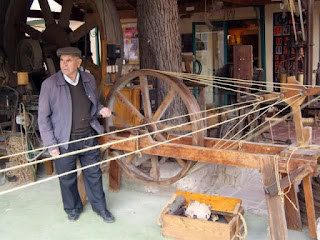
                                                                                                                                                                                                   One reader in Spain who enjoyed my post about the production of Esparto, (2/6/12 -scroll down to view this), sent me these photos showing two men demonstrating the craft in the museum in Cieza, Spain.

The next post will be in a fortnights time on the 15th. of July.Thanks for your company, Cathy.

Tuesday, 12 June 2012

Old meets new in Calabardina, Murcia, Spain.

Welcome to this week's post. This part of Spain is still  a fascinating blend of the traditional and modern way of life. During the years under Franco, (1936-1975) contraception, divorce, abortion and homosexuality were illegal and women were not even allowed to work without the written permission of their husbands. Now all of this has changed; divorce, abortion and gay marriage have all been legalised. (Although the current right wing government is trying to repeal the latter).

Most Spanish people in my experience welcome these changes, but of course (as in every country) one never knows how much is hidden. We were once with two older Spanish chaps when a dreadful comedy programme with a man in drag came on. One of the two muttered, "In Franco's time this would never have been permitted," whilst the other laughingly made a throat cutting gesture.

Calabardina is a small holiday resort close to Aguilas. Recently there was a local bank holiday week-end in celebration of the Crosses' of May and Carmen, the Virgin of the sea.


 On Friday a street was closed off and a large awning erected. On Saturday evening from ten p.m. there was to be music and dancing and free sardines to eat. A chiringuito  appeared-a  snack bar selling hot chocolate and churros (a delicious and horrendously fattening deep fried pancake with sugar.)


Some men had previously arrived in a van and erected this extra-terrestial saucer on the nearby waste ground.


On the Sunday morning we found a cross and small statue of the virgin being carried along the road towards the jetty. It was accompanied by the 'faithful' (mostly old), the obligatory marching band (mostly young) and a motley crew of onlookers (including ourselves and a lady in traditional dress.)
At the end of the jetty thirty or so people were about to go on a diving expedition. Dressed in wet suits they were lugging oxygen cylinders around and resembled huge black beetles.

                                        The church group were in their Sunday Best.

The band played on.
The two groups met in the middle. The divers in their suits and the faithful carrying the Virgin. The divers, (depending on their nationality) either continued with their preparations or just stood open-mouthed. The church group simply turned around to return back along the jetty.
Many others (mostly Spanish) were happily enjoying the unusually hot weather. They swam, sunbathed or chatted on the beach seemingly oblivious of the scene just a few yards away.

In my next post we look around here a little more and find out what went in that saucer!

If you would like to leave a comment on this page, I'm told that it is easier if you 'un tick' - 'Remember my password'. Otherwise I would be really pleased to receive any comments at my Email address : writerinaguilas@gmail.com 

I do hope that you join me again in a fortnights time on or after the 1st of July. Please forward my blog address to any of your friends who you think might enjoy it, Cathy.

Saturday, 2 June 2012

El esparto - The grass

Welcome to this week's post. I thought I'd tell you about an ancient craft that's dying out in Murcia. We were intrigued to find several place-names here contain the word 'esparto.'

On looking this up in our much thumbed dictionary it only said, 'grass'. However we've learnt that el esparto, has a long and interesting history. The esparto is a sturdy grass that grows in the hills and all along the coast of Murcia. Along with fishing it was the chief source of income in this region up until the middle of the last century.


The esparto was cut down by hand and hauled by horse and cart to one of the local bays known as cocedores - cookers. In these bays small circular stone walls were built up in the water to form a zone where the people could work. The esparto was first immersed in the water to soften it, it was then raked and fanned out before being made into reels. It must have been hard back-breaking work getting it in and out of the cart and then lugging it into the water. Cold and tough on the hands in the winter and hot heavy work in the summer.

(Nowadays these areas, protected from the rest of the sea are perfect for children to play in, and being that little bit warmer are also good for ageing Brits to paddle in !)
The esparto was then taken by horse and cart to one of the twenty factories in the area to be made into rope.This in turn was used to make any number of things but in particular the rope soled sandals - alpargatas. (Some of us may remember them from the seventies, when I seem to recall them being called espadrilles).
An article in a local book  (Junto del mar, by Ramon Jimenez Madrid) details that this was also immensely hard and dangerous work. In the factories women sometimes had their hands or fingers crushed by heavy mallets. He also states that with the introduction of plastic and the demise of the industry many of these factories were deliberately set alight for the insurance money.
There still exist a small number of men working the esparto by hand. You can meet one or two of them and purchase articles at the Saturday market in Aguilas.  


I met this chap at a very English garden party in the mountains near Mazarron. He was plaiting the esparto in much the same way that we would plait hair. It would then be glued onto the soles of the sandals. He'd worked the esparto since he was a boy, and his father and grandfather before him. He had various objects on display: sandals, a wine/olive container, a massive basket to keep bread fresh, two large containers to transport goods on a donkey or mule and, (I did struggle to translate this) a container to put a ferret in, to attract rabbits when out hunting!
Incidentally the garden party was to raise money for a charity for cancer relief. We don't know many English people here, so it was a surreal experience to be in the middle of the mountains with about a hundred other Brits.
We had tea and cakes, a raffle, various traditional English fete type games and a rendition of songs from the musical Oliver! (As you can see from the photo this was about a month ago and the weather was more typical of English fete weather than Spanish weather - although it didn't rain.)
The couple who live here speak Spanish and are integrated into the Spanish community, but many Brits live in totally British enclaves.Some spend twenty or thirty years here without being able to speak a word of Spanish.They have British plumbers, electricians, solicitors, taxis, pubs and social clubs. And of course they can easily obtain fish and chips and a full English breakfast (not necessarily at the same time.) When we ask our Spanish friends how they feel about this they are always very polite but I suspects that they don't like it. I don't think we British would do either, but they tolerate it as they are naturally welcoming and having foreigners here is a major source of income, especially during the current crisis.

Next post - Old meets new in Calabardina, Murcia. Why has this extra-terrestrial saucer landed ?

If you have any comments on this blog I'd love to hear from you. It is (apparently) easier to comment on this page if you don't tick 'remember my password.' If you struggle as I do with technology just email me at : writerinaguilas@gmail.com
Please pass on the blog address to any of your friends who might be interested. I look forward to your company in a fortnight's time, on or after the 17th of June, Cathy.