Friday, 10 August 2012

On to Benidorm with the Aguilas Housewives.

In my last post (which if you missed it, can be read a little further down this page), I was on a day trip with the association of the Aguilas housewives. Having been to Calpe and Altea we continued on our way to Benidorm.
Altea
We stopped at what appeared to be a small bar for lunch, but it had a distinct resemblance to the tardis from Dr Who. There were around a dozen seats outside, thirty in the bar, an inner room of two hundred, and then ours which sat about another seventy. Because Spanish families are so large family get-togethers often take place in these bar/restaurants and many bars which appear small at first glance have a huge room further inside. We had a large and sadly mediocre meal - salad, a so called Paella, (which was basically rice with some chicken or rabbit shot into it) and then some pre-cooked 'pressed pork' with about six greasy chips. However the committee were really kind to me and came to ask me several times if I was OK.
We got back into the coach and went on to Benidorm. The view from the coach window,(shown here), filled me with gloom.It appeared to be even worse than I'd imagined.

 I am however reliably informed, (by the members of a walking group), that, like so many resorts here, once you get into the countryside it's extremely beautiful.


When we reached the town at the back of the beach it consisted of tatty souvenir shops, bars and restaurants. I was greeted in English everywhere that I went. Egg and chips, and cups of tea abounded. Benidorm was one of the first places that opened up to the tourist trade in the sixties and unfortunately it shows. Just as they did in Altea all the ladies walked around in groups of twenty or so. There is a definite feeling that there is safety in numbers when one is out with the Spanish. A shopkeeper in a leather shop looked slightly alarmed when we all invaded en masse but he needn't have worried.

The beach itself is massive and sandy but the overcast weather certainly didn't show it off at its best. The Spanish women that I went with didn't seem to like it much either. I think they were just on the trip for a day out, and the chance to met up with friends away from the constraints of their family.
As the evening drew on it took on the appearance of the English seaside in winter. The bright lights illuminating an almost deserted beach. I imagine that now,in the middle of August, you would have to fight to get a space for your beach towel.
Everyone on the coach on the way back was subdued quite a contrast from the outward journey. It was about ten pm and it had been a long day. However when we reached the close by town of Lorca it was as though a switch had been flicked on unbeknown to me. All the ladies started to shout, laugh and screech. Many rang family and friends to excitedly inform them at top volume that they were almost home.

Aerial view of Lorca castle.
                                                      
We travelled onwards to Aguilas some fifteen miles away everyone continuing their animated conversations. At last the castle perched above Aguilas hove into view and everyone started to sing a traditional and very lovely song about Aguilas.


I felt very privileged to have been accepted into this group of lovely women. All in all it was a long interesting and tiring day. My Spanish may have even improved a little!
As always thank you for reading. My next blog will be the week-end of the 8th of September. It will detail a fascinating encounter, which led to us hearing rumours about strange goings on in post WW11 Murcia, and a link with Hitler's chauffeur!
All comments via the page, email or face book are very welcome. Speak to you next month, Cathy

Gracias para leer mis paginas. Mi blog proximo sera el fin de semana 7 de setiembre y es sobre rumores de Murcia despues de la Guerra del Mundo Segundo y ! un enlace con el chofer de Hitler!

Friday, 13 July 2012

On a wing and a prayer- out with the Aguilas housewives.

Last year we were struggling with the local accent - we still are! To be fair our Spanish pharmacist friend from Almeria, also struggles with it. Recently she had a problem understanding a local shepherd when he asked her if she had anything for his goat's diarrhoea.
Local people tend not to pronounce the letters 's' and 'd'. This does not make the words sound as they did when we learnt them at the local college in England, e.g. 'Buenos Dias' is pronounced 'Buenodia', 'Pescado' (fish) is pronounced 'Pecao', and Estamos (we are) is 'etamo', and so on. Aguilas itself also has words peculiar to only Aguilas. With this in mind when I saw an advert about the local WI, I decided to join in the hope of improving my listening skills.

View of the castle in Aguilas from one of the two beaches.

When I went into Aguilas to join, I took my husband with me for support. On finding the front door of their building, I hesitated. My husband rang the bell, the door opened electronically and he firmly pushed me up a flight of stairs. I entered a tiny office and was faced with about five middle-aged ladies squashed behind a small desk. They all looked up at me in surprise. I asked if I could join - they looked astounded - "It would be 12 Euros." "OK" We then had a difficult conversation about how we came to be in Aguilas, which my husband helped me with as my nerves had rendered me almost dumb, (a most unusual occurrence according to him). A card was issued. I was now an official member of :-
The Association of Housewives, Worshippers and Users of the Virgin of Dolores, of Aguilas. It didn't seem to matter that I was not a worshipper, a user or indeed, even a Catholic. They told me that some of them met every Tuesday to embroider or sew - my heart sank - sewing! (When at school my mother completed every item that I ever started). However  I went along several times clutching a tiny embroidery which I've been doing for about ten years now. The embroidery progressed quite well but sadly the ladies remained almost incomprehensible to me. I still couldn't crack the accent.


A few months later they had a trip to Benidorm. (It was advertised on hoardings and lampposts around the town, the normal method to convey information). I'd never been to Benidorm and thought that listening to a whole day of Spanish would be good for me. Stomach churning I met about fifty mostly elderly ladies waiting at the port at eight a.m. on a chilly February day.

We all got on the coach and I was surrounded by excited Spanish women all chattering, gesticulating and shouting at once. We set off and the president (an always immaculately dressed woman aged about seventy) started the announcements over the microphone immediately saying how pleased she was to be out with, The Housewives of Aguilas, Worshippers and Users of the Virgin of Dolores, of Aguilas. (A previous Spanish teacher used to say of Spanish, "Why use one word when you can use twenty").
Everyone continued laughing and talking throughout the announcements. It suddenly quietened. There was just a low murmuring, the ladies were crossing themselves and I realised that prayers were being offered up for a good day and an improvement in the weather. This was followed by a stream of what appeared to be filthy jokes with all the women laughing uproariously and various ones taking over the mike. Then they all started to sing. So far it wasn't how I imagined a day out would be with the English WI. ( I could be wrong - let me know if you're a member).
I sat next to a woman who like most had come with several female members of her family. They all worked with their husbands who ran the local children's fun-fair. One sold sausages and fried foods, one candy floss and I never did manage to translate what the other one did.

We travelled up the coast and stopped at a bar for a mid-morning break around ten a.m. Two of my new friends had large glasses of red wine to calentarse - warm themselves.They had saved me a seat and bought me (what else?) a cup of tea.  They were kind to me and I was delighted to be able to converse with them.
They had an interesting life. The fair opens in Aguilas for week-ends and holidays in the winter and they travel all over Spain with it in the summer. However with the deepening economic climate the takings were well down.
We finally reached Calpe which has a pretty port. A restaurant displayed massive trays of sea food for people to choose from for lunch later on. (Unfortunately we didn't lunch here).We all wandered vaguely around the port, en masse of course. Everyone was complaining about the weather which was chilly and grey. On the rare occasions when it rains in Aguilas the streets are deserted, because people simply don't venture out in the rain unless it's essential - yes, I know - they wouldn't have gone out much in England this spring would they?


Then we all got back onto the coach to Altea, which was a photographer's paradise,but as is always the way with coach trips far too short a stay, just forty-five minutes.


I leave you here to view some of the delights of Altea and to brace yourselves for the horrors of Benidorm. My next blog will be in a month's time as many of my readers are away on holiday.(Especially the Spanish who tend to take the whole of July and or August off). I hope you all have a lovely time.


Many thanks for reading.
All comments are very welcome either at the link or directly to me at
writerinaguilas@gmail.com

Gracias para leyendo, espero que te guste. Si tienes algunos comentarios escribirme a
writerinaguilas@gmail.com

Friday, 29 June 2012

Old meets new in Calabardina, Murcia, continued

Aguilas - The Crosses of May.

Welcome. This post is about a fiesta in Calabardina and follows on from my last post.( If you would like to read that one first just scroll further down the page).

Having encountered assorted divers on the jetty, the statue of the Virgin was carried up and down two or three streets to the accompaniment of a band. Some houses had decorated crosses hung up outside.


There was a competition for the best decorated cross and these were displayed under the awning in the street.I think they deserved a better background..


Whilst walking around we encountered some of our neighbours - cue an impromptu chance to practice our Spanish above the noise of the band whilst walking in a throng of people. After this we decided we needed to recuperate and went for a cup of tea, (well, we are English), and then to join everyone else on the beach.


Something that hasn't changed here is the importance of the family. Most outings and events seem to involve a minimum of ten people. In many households extended families of between eight and twenty people will all lunch together every Sunday. On birthdays and other celebrations it's obligatory to invite the entire family. May is the month for first communions and weddings. Many of our Spanish friends have been to events involving two or three hundred members of the family for three week-ends in a row during this month.


On the beach, as elsewhere, Spanish people like to be close. They are exceptionally friendly to everyone and the concept of having your own space simply doesn't exist!


We'd read on a poster that we'd be able to buy a portion of paella at around two thirty so we went along.When we arrived at three p.m. it was (to our astonishmen) in full swing. (Normally everything is at least half an hour later than announced.)
This photo shows everyone under the awning in the middle of the street - a little like the recent Jubilee celebrations in Britain, but without the obligatory British weather!
They seemed to have done enough for everyone!  


It tasted delicious, and at three Euros a portion (about £2.75) this particular Brit thought it was great value.


I hope you have enjoyed this blog. I love getting your feedback especially from other countries such as Germany, France and the USA as well as Spain and England. If you have any comments please send them to me at: writerinaguilas@gmail.com
Espero que has gustado este blog. Me gusta mucho tener los pensamientos de gente en otros paises, como Espana, Alemania, Francia y Los Estados Unidos.  Si tienes algunas pensamientos sobre el 'blog' escribes a  writerinaguilas@gmail.com
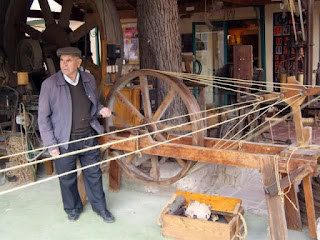
                                                                                                                                                                                                   One reader in Spain who enjoyed my post about the production of Esparto, (2/6/12 -scroll down to view this), sent me these photos showing two men demonstrating the craft in the museum in Cieza, Spain.

The next post will be in a fortnights time on the 15th. of July.Thanks for your company, Cathy.

Tuesday, 12 June 2012

Old meets new in Calabardina, Murcia, Spain.

Welcome to this week's post. This part of Spain is still  a fascinating blend of the traditional and modern way of life. During the years under Franco, (1936-1975) contraception, divorce, abortion and homosexuality were illegal and women were not even allowed to work without the written permission of their husbands. Now all of this has changed; divorce, abortion and gay marriage have all been legalised. (Although the current right wing government is trying to repeal the latter).

Most Spanish people in my experience welcome these changes, but of course (as in every country) one never knows how much is hidden. We were once with two older Spanish chaps when a dreadful comedy programme with a man in drag came on. One of the two muttered, "In Franco's time this would never have been permitted," whilst the other laughingly made a throat cutting gesture.

Calabardina is a small holiday resort close to Aguilas. Recently there was a local bank holiday week-end in celebration of the Crosses' of May and Carmen, the Virgin of the sea.


 On Friday a street was closed off and a large awning erected. On Saturday evening from ten p.m. there was to be music and dancing and free sardines to eat. A chiringuito  appeared-a  snack bar selling hot chocolate and churros (a delicious and horrendously fattening deep fried pancake with sugar.)


Some men had previously arrived in a van and erected this extra-terrestial saucer on the nearby waste ground.


On the Sunday morning we found a cross and small statue of the virgin being carried along the road towards the jetty. It was accompanied by the 'faithful' (mostly old), the obligatory marching band (mostly young) and a motley crew of onlookers (including ourselves and a lady in traditional dress.)
At the end of the jetty thirty or so people were about to go on a diving expedition. Dressed in wet suits they were lugging oxygen cylinders around and resembled huge black beetles.

                                        The church group were in their Sunday Best.

The band played on.
The two groups met in the middle. The divers in their suits and the faithful carrying the Virgin. The divers, (depending on their nationality) either continued with their preparations or just stood open-mouthed. The church group simply turned around to return back along the jetty.
Many others (mostly Spanish) were happily enjoying the unusually hot weather. They swam, sunbathed or chatted on the beach seemingly oblivious of the scene just a few yards away.

In my next post we look around here a little more and find out what went in that saucer!

If you would like to leave a comment on this page, I'm told that it is easier if you 'un tick' - 'Remember my password'. Otherwise I would be really pleased to receive any comments at my Email address : writerinaguilas@gmail.com 

I do hope that you join me again in a fortnights time on or after the 1st of July. Please forward my blog address to any of your friends who you think might enjoy it, Cathy.

Saturday, 2 June 2012

El esparto - The grass

Welcome to this week's post. I thought I'd tell you about an ancient craft that's dying out in Murcia. We were intrigued to find several place-names here contain the word 'esparto.'

On looking this up in our much thumbed dictionary it only said, 'grass'. However we've learnt that el esparto, has a long and interesting history. The esparto is a sturdy grass that grows in the hills and all along the coast of Murcia. Along with fishing it was the chief source of income in this region up until the middle of the last century.


The esparto was cut down by hand and hauled by horse and cart to one of the local bays known as cocedores - cookers. In these bays small circular stone walls were built up in the water to form a zone where the people could work. The esparto was first immersed in the water to soften it, it was then raked and fanned out before being made into reels. It must have been hard back-breaking work getting it in and out of the cart and then lugging it into the water. Cold and tough on the hands in the winter and hot heavy work in the summer.

(Nowadays these areas, protected from the rest of the sea are perfect for children to play in, and being that little bit warmer are also good for ageing Brits to paddle in !)
The esparto was then taken by horse and cart to one of the twenty factories in the area to be made into rope.This in turn was used to make any number of things but in particular the rope soled sandals - alpargatas. (Some of us may remember them from the seventies, when I seem to recall them being called espadrilles).
An article in a local book  (Junto del mar, by Ramon Jimenez Madrid) details that this was also immensely hard and dangerous work. In the factories women sometimes had their hands or fingers crushed by heavy mallets. He also states that with the introduction of plastic and the demise of the industry many of these factories were deliberately set alight for the insurance money.
There still exist a small number of men working the esparto by hand. You can meet one or two of them and purchase articles at the Saturday market in Aguilas.  


I met this chap at a very English garden party in the mountains near Mazarron. He was plaiting the esparto in much the same way that we would plait hair. It would then be glued onto the soles of the sandals. He'd worked the esparto since he was a boy, and his father and grandfather before him. He had various objects on display: sandals, a wine/olive container, a massive basket to keep bread fresh, two large containers to transport goods on a donkey or mule and, (I did struggle to translate this) a container to put a ferret in, to attract rabbits when out hunting!
Incidentally the garden party was to raise money for a charity for cancer relief. We don't know many English people here, so it was a surreal experience to be in the middle of the mountains with about a hundred other Brits.
We had tea and cakes, a raffle, various traditional English fete type games and a rendition of songs from the musical Oliver! (As you can see from the photo this was about a month ago and the weather was more typical of English fete weather than Spanish weather - although it didn't rain.)
The couple who live here speak Spanish and are integrated into the Spanish community, but many Brits live in totally British enclaves.Some spend twenty or thirty years here without being able to speak a word of Spanish.They have British plumbers, electricians, solicitors, taxis, pubs and social clubs. And of course they can easily obtain fish and chips and a full English breakfast (not necessarily at the same time.) When we ask our Spanish friends how they feel about this they are always very polite but I suspects that they don't like it. I don't think we British would do either, but they tolerate it as they are naturally welcoming and having foreigners here is a major source of income, especially during the current crisis.

Next post - Old meets new in Calabardina, Murcia. Why has this extra-terrestrial saucer landed ?

If you have any comments on this blog I'd love to hear from you. It is (apparently) easier to comment on this page if you don't tick 'remember my password.' If you struggle as I do with technology just email me at : writerinaguilas@gmail.com
Please pass on the blog address to any of your friends who might be interested. I look forward to your company in a fortnight's time, on or after the 17th of June, Cathy.


Friday, 18 May 2012

Lorca - one year on.

Welcome to 'Writer in Aguilas'. This post is about the beautiful and historic nearby town of Lorca, which you may remember was hit by an earthquake on May 11th of last year (2011). We've made several visits there in the past to see the castle ruins which dominate the town and to wander around its narrow streets which are  crammed with historic buildings and churches - not to mention a whole lot of atmospheric bars and pretty squares to sit in whilst nursing a glass of the local wine.


Sometimes old and new are juxtaposed a little too closely for comfort.


Last year at Easter our lovely Spanish friends (Juan and Hortensia) showed us around the town before we watched the fantastic Easter processions with them. Juan is employed by the council and that particular visit found us to be not only virtually the only foreigners present but also to be watching the processions from the same prestigious bank of seats as the mayor and other local dignitaries. We were even seen on the local TV station!       


                                     Then, just 3 weeks after that visit the earthquake struck.


The first tremor measured 4.5 on the Richter scale and hit at 17.05 local time.The main shock of 5.1 struck at 18.47. and occurred just one kilometre under the surface, Tremors were observed not only in Aguilas but also hundreds of miles from the epicentre, in Alicante and Madrid. In total it released a surface energy equivalent to over 200 tonnes of TNT.
Nine people were killed and more than three hundred injured. Three thousand people slept out in tents for over a week. Lines of cars lay devastated under rubble.To our horror we watched live pictures on the TV and saw a massive bell fall from its tower almost hitting the reporter. (You can see this on the Internet). Thankfully no-one we knew was injured.
Many people who have holiday homes in Aguilas are living in them permanently since the earthquake.On asking a neighbour if her home had been damaged, she replied quietly, "There is no home in Lorca that hasn't been damaged." Her own and those of her elderly neighbours has been demolished. Many people were unable to retrieve any possessions and those with no house insurance have lost their homes forever.

 Our friends were keen for us to visit and see the damage for ourselves eight months on. At first sight we didn't think much had changed because large plastic sheets and hoardings are in-between the buildings hiding the demolished sites behind them. It was only when we looked around with Juan that we saw the devastation. They live on the sixth floor in a twelve storey block of flats. We went down into the basement with them and saw the massive cracks there and on the ground floor. The people living on the first three floors are still not allowed to return. In the immediate aftermath every house was inspected and colour coded by a splash of paint on the outside; red for 'dangerous,' green for 'safe,' they are still to be seen on every building, a chilling reminder of the horror that happened that day.
Everyone we met was so pleased that we had gone to visit. They said that many people were frightened to come. Although the entire region lies on a fault this was the first serious earthquake in many years.
The inside of every church is damaged where the roofs fell in. Many statues are now headless and the facades of buildings are supported by great concrete staves or by scaffolding. However the people are determined and resilient, shops are open for business.

Juan took us to a local bodega to sample some wine. There was nowhere to sit so the owner hastily brought out chairs for us and a barrel for a table and we were set up in the street, people, cars and mopeds winding their way past us! Close by wine was being decanted from massive barrels. When we remarked on how good the wine was Juan immediately bought us a bottle. We find this is typical of Spanish people's generosity.


 (In the past we have been given huge bags of oranges, mandarins, lemons and artichokes.We've also had a plate of figs, and recently a delicious portion of the lentil stew that our neighbour was cooking for her husband's lunch! We have learnt that if we say that we like anything our Spanish friends and neighbours will insist on giving it to us).


Back in the street, I suspect that these chaps knew I was taking their photo. Or perhaps the wine wasn't to their taste.


Then we were off to another bar for a drink.The bar had moved location due to the earthquake but it was still packed and serving what looked like a very good paella. We were starting to lose our command of Spanish by now!


We went back to Juan's flat where we had that typical Spanish dish Fondue! - it was excellent, and a little more local wine. (Our Spanish conversational skills were going downhill even  more rapidly than the wine - but we didn't care anymore!)
   On a serious note when the earthquake struck our friends' daughter was having an English lesson in the block of flats opposite. We looked across the road - all that was left was a plot of land. Luckily when the first tremor happened most people including our friends went out into the streets. They said it sounded like a massive explosion and that everything shook including the glasses in their cabinet - amazingly not one was damaged.
   The people of Lorca have been promised millions of Euros from the government and some rebuilding has started but Spain's economic state is worse than Britain's. Unemployment is at 23% and youth unemployment at 40 % Many people may never get their homes back and all shake their heads when asked, 'How long before it's rebuilt?'
   In spite of all this the people are determined and outwardly cheerful. The Easter celebrations this year were as breath-taking as ever and the castle has re-opened for business.There are lots of interesting and beautiful buildings and museums to see and it's still a lovely town. If you have the opportunity, please show your support by visiting - you will be well rewarded.
The next blog will be in a fortnights time - Sunday 3rd June. It will feature a dying craft and an English garden party in Murcia.
 I'm delighted to find that people are viewing this blog from as far afield as Russia and the USA. I would be very pleased to receive comments either via the link or at  writerinaguilas@gmail.com 
                                      Thanks for your company, Cathy.

Saturday, 5 May 2012

The day of Dolores

Hi and welcome,
this blog is about our visit to a festival in Aguilas - the Day of Dolores, (the virgin of suffering.)
The majority of people in Spain are still nominally Catholic, but the number of 'practising Catholics' is diminishing. However every town and village in Spain has their 'own Saint' and thus their own Fiesta Day - so you could go to a fiesta somewhere in Spain every day of the year! They are very popular as everyone, except essential services (such as hospitals and bars) gets a day off.


 We arrive at the Plaza de Espana around mid-day on a beautiful, sunny day, to find it packed. Waiters are dashing across the road with trays of drinks and tapas. After about an hour people start arriving in traditional Murcian dress; the women in blouses and beautifully embroidered full skirts in primary colours with matching aprons and shawls. Coloured laces criss-cross their white stockinged legs.


   The young women are exquisite. Their glossy dark hair is piled up on their heads, intricately plaited or curled, and held in place with coloured ribbons, combs and sparkling beads. With them are children, toddlers and even tiny babies, all in costume from their minute shoes upwards.


Men too are in costume. Youths with studs in their chins and spiky hair wear royal blue silken trousers, with white or coloured tunics. They chat and laugh with their friends, they seem to be proud to be taking part and having fun.
   The noise level rises and chatting people drift in and out of the church where a mass is taking place.Traditional music blasts out of speakers. When the mass finishes, people queue airport style around blue velvet covered barriers, to hand bunches of flowers to a man who is cramming them into a metal tower fifteen foot up in to the air.
   The speeches start as the marching band arrives playing drums, cornets and trumpets. There isn't enough room for them to reach the stage so they play in the street instead. Ornate and large displays of flowers are presented by various groups - cue applause and shouts of "Viva" from the crowd. The noise level is tremendous, the atmosphere a bit like being at a very good-natured football match.


 An enormous statue of the Virgin is carried out from the interior of the church to the doorway and the square resounds with  cries of, "Viva la Virgin de Dolores!" A group from the local village sets up on stage, (aged from three to what looks like ninety three,) they are equipped with guitars and castanets. A traditional saeta - a lament is sung. Even the crowd pause to listen to its chilling sadness. Then there are displays of traditional dancing and more shouts of, "Viva" from the crowd. More chairs and tables are brought out of bars - the waiters activity is frenetic!
    By early afternoon people are staring to drift away. After all the Virgin will  be carried out properly and paraded around the town with attendants and the band playing later tonight. This is just the start of a series of parades that take place throughout Easter week.

Interestingly this isn't an event put on for tourists - there are no more than a dozen of us foreigners present. It's simply a celebration by local inhabitants, everyone enjoying the colour and noise. It makes me wonder if we're losing something in England with our headlong rush into modernity. Soon even the Morris Men will be gone.What do you think? I'd love to have your comments. (If the comments link is difficult my web address is writerinaguilas@gmail.com )

In a weeks time, it will be a year since the earthquake in nearby Lorca, so in my next blog, ( Sunday 20th May approximately,) I'll be sharing my recent visit there with you.
Thanks for joining me.